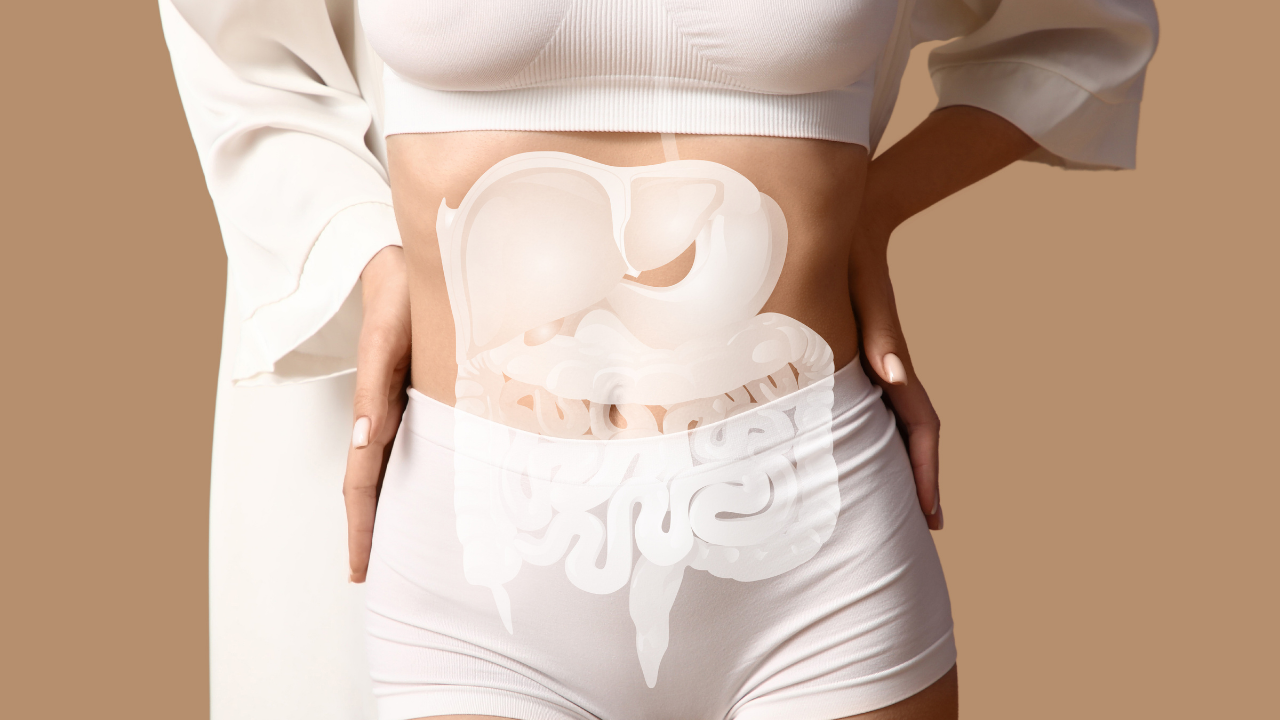
The Menopause-Gut Connection: Why Your Digestion, Belly Fat, and Hormones May Feel Different
Jul 20, 2026Ever feel like your stomach suddenly has a mind of its own?
One day, you are bloated enough to unbutton your jeans after lunch. The next day, you are wondering why you have not had a normal bowel movement in three days. Foods you have eaten for years suddenly leave you uncomfortable, and that stubborn belly fat seems determined to stick around, no matter how “healthy” you are eating.
Most conversations about menopause and metabolism focus on estrogen, muscle, and blood sugar. Those things absolutely matter, but they often leave out another system involved in all three: your gut.
Your gut microbiome is not just responsible for digestion. It also plays a role in inflammation, blood sugar regulation, immune function, and the way your body processes estrogen. As you move through perimenopause and menopause, that relationship begins to change.
Meet the estrobolome
Inside your gut lives a community of bacterial genes known as the estrobolome. Think of it as your gut’s estrogen recycling team.
After estrogen has done its job, your liver processes it and packages it for elimination. Certain gut bacteria produce an enzyme that can “unpack” some of that estrogen, allowing it to be reabsorbed into the bloodstream instead of leaving the body through stool.
In other words, your gut bacteria may influence how much estrogen remains available to your body.
This is not a one-way relationship. Estrogen also affects which bacteria thrive in the gut. Your hormones influence your microbiome, and your microbiome may influence how hormones are processed.
They are in an ongoing conversation, although during menopause, it can feel like no one checked the group chat before making changes.
What changes during menopause
Research comparing premenopausal and postmenopausal women suggests that menopause is associated with changes in the gut microbiome, including lower microbial diversity and shifts in the types of bacteria present.
Microbial diversity refers to the variety of organisms living in the gut. In general, a diverse microbiome tends to be more resilient and better able to perform a range of functions.
Some studies have found that the gut microbiome of postmenopausal women becomes more similar to that typically seen in men. Researchers have also found lower levels of certain bacteria associated with gut barrier and metabolic health, including Akkermansia muciniphila, in some postmenopausal women.
What might this look like in real life?
You may suddenly feel bloated after eating a meal that never bothered you before. You may be drinking water like it is your full-time job and still feel constipated. Your belly may look fairly normal in the morning and then appear six months pregnant by dinner.
That does not mean every digestive symptom is caused by menopause. However, hormonal changes may be one reason your digestive system no longer responds exactly the way it did in your 30s.
What about “leaky gut” and inflammation?
Declining estradiol and progesterone have been proposed as possible contributors to increased intestinal permeability, sometimes referred to as “leaky gut.”
The intestinal lining acts as a barrier. It allows nutrients to pass through while helping keep potentially harmful microbial byproducts inside the digestive tract. If that barrier becomes less effective, certain compounds may enter circulation and contribute to low-grade inflammation.
This may sound familiar if you frequently feel “puffy” or inflamed. Your rings are tight by evening. Your waistband leaves deep marks. You wake up stiff and wonder what athletic event you participated in while sleeping.
It is important to be honest about the evidence: the connection between menopause, intestinal permeability, and systemic inflammation is still being investigated. The available studies are relatively small and not always consistent. It is a plausible biological pathway, but it is not yet a firmly established cause-and-effect relationship.
What is more consistently supported is that menopause is associated with changes in microbiome composition and diversity. Researchers are still determining exactly how those changes affect estrogen metabolism, inflammation, and long-term health.
Your gut may be one part of the belly-fat puzzle
Your gut is not the only reason abdominal fat becomes more stubborn during menopause, but it may be one piece of the puzzle.
Estrogen influences where your body stores fat, how sensitive your cells are to insulin, and how muscle and fat tissue function. It may also influence which bacteria thrive in the digestive tract.
As estrogen declines, several systems shift at the same time. This helps explain why the strategies that worked in your 30s may not produce the same results in your late 40s or 50s.
Your body did not forget how to function. It is responding to a different hormonal environment.
Unfortunately, it did not send you an updated owner’s manual.
Why this is not just a “take a probiotic” story
When people hear “gut health,” the first recommendation is often to take a probiotic.
Probiotics may be useful in certain situations, but gut health cannot be reduced to one capsule or one bacterial strain. The strongest foundation for a resilient microbiome is generally the variety of foods you eat consistently.
Your gut bacteria do not care that you bought the expensive probiotic from the refrigerated section if they are being fed the same three foods every day.
Microbial diversity is supported by dietary diversity. Different bacteria prefer different types of fibers and plant compounds. The more varied the diet, the greater the opportunity to support a wider range of beneficial organisms.
There is some strain-specific probiotic research. One randomized, placebo-controlled trial involving 135 adults with abdominal obesity found that participants taking Bifidobacterium animalis subsp. lactis CECT 8145 for three months experienced improvements in some measures of abdominal fat. The reduction in visceral fat was statistically significant among the women in the study, and Akkermansia levels increased alongside the improvement.
That is interesting, but it is one study. It was not conducted specifically in menopausal women, and it does not mean that every probiotic will produce the same result.
So yes, some probiotics may have benefits. No, they are not a magic belly-fat eraser hiding next to the yogurt.
What actually supports your gut during this transition
Gut health is part of the Go pillar in the Eat, Move, Go framework. “Go” includes digestion, regular elimination, sleep, stress management, and the daily habits that help your body function consistently.
Here are the strategies that matter most.
Eat a variety of fiber-rich foods
Fiber quantity matters, but fiber diversity matters too.
Different bacteria prefer different fibers. Eating broccoli every day is nutritious, but it does not provide the same range of fibers as rotating among vegetables, fruit, beans, lentils, oats, barley, nuts, seeds, and whole grains.
Think variety across the week rather than perfection at every meal.
For example, you might add berries and chia seeds to breakfast, lentils or chickpeas to lunch, and roasted vegetables or a whole grain at dinner.
You do not need 30 different plants on your plate tonight. Start by adding one or two foods you are not currently eating regularly.
Include fermented foods when tolerated
Foods such as yogurt, kefir, sauerkraut, kimchi, miso, and other fermented products may introduce live microorganisms and support microbial diversity.
You do not need to eat an entire jar of sauerkraut to receive potential benefits. In fact, your family may appreciate it if you do not.
A serving of yogurt, a small glass of kefir, or a few spoonfuls of fermented vegetables can be a reasonable place to start.
Choose foods you enjoy and tolerate well. If fermented foods worsen bloating or digestive symptoms, more is not necessarily better.
Eat adequate protein
Protein is essential for maintaining muscle during menopause, but it also contributes to digestive and gut-barrier health.
The cells lining your intestinal tract require amino acids to maintain and repair tissue. Protein also supplies the building blocks needed to produce digestive enzymes and other compounds used throughout the body.
Aim to include a meaningful protein source at each meal, such as eggs, fish, poultry, Greek yogurt, cottage cheese, tofu, tempeh, beans, lentils, or lean meat.
Protein is doing more than helping you feel full. It is supporting muscle, metabolism, and tissue repair at the same time.
Limit ultra-processed foods and excess alcohol
A diet high in ultra-processed foods is associated with lower diet quality and may negatively affect the microbiome and gut barrier. Excess alcohol may also disrupt intestinal function and contribute to inflammation.
This does not mean you can never eat chips, dessert, or enjoy a glass of wine.
It means those foods should not make up the foundation of your diet.
Your gut can handle a cookie. It becomes more challenging when the cookie, protein bar, frozen dinner, and wine are all part of the same daily “wellness plan.”
Support regular bowel movements
Let’s talk about something no one likes talking about: poop.
Regular, comfortable bowel movements are an important part of digestive and hormone health. When stool moves slowly through the colon, compounds that were intended for elimination remain in contact with gut bacteria for a longer period.
That may increase the opportunity for some estrogen metabolites to be deconjugated and reabsorbed instead of being removed from the body.
Constipation can also leave you feeling bloated, heavy, and mysteriously five pounds larger by the end of the day.
Supporting regularity usually requires more than simply adding a fiber supplement. Adequate fluid, movement, dietary fiber, sufficient food intake, stress management, and a consistent bathroom routine all matter.
Increasing fiber too quickly without increasing fluid can also backfire. That is how someone ends up eating bran cereal, chia seeds, and a fiber bar while wondering why their stomach now feels like a concrete mixing bowl.
Increase fiber gradually and pay attention to how your body responds.
The bottom line
Gut health during perimenopause and menopause is not a wellness add-on. It is connected to digestion, inflammation, blood sugar regulation, estrogen metabolism, and the way your body adapts to hormonal change.
Your gut is not working against you. It is adjusting to a new hormonal environment, just like the rest of your body.
The encouraging part is that your microbiome is responsive to daily habits. Every meal is an opportunity to support the bacteria involved in digestion, gut-barrier function, and metabolic health.
That is why Go is one of the three pillars of the Eat, Move, Go framework in my signature program, The Reset Routine: A 90-Day Guide for Women 40+ Navigating the Menopause Transition. Going is not just about having a bowel movement. It is about supporting the systems that help your body clear waste, regulate hormones, manage inflammation, and feel more like itself again.
This is exactly the kind of connection we build into the Reset Routine. It is not just about what to eat. It is about understanding why those choices matter for what your body is doing right now.
References
Liaquat, M., Minihane, A. M., Vauzour, D., & Pontifex, M. G. (2025). The gut microbiota in menopause: Is there a role for prebiotic and probiotic solutions? Post Reproductive Health, 31(2), 105–114. https://doi.org/10.1177/20533691251340491
Lim, M. J. S., Parlindungan, E., See, E., Gan, C. H., Yap, R., & Yong, G. J. M. (2026). Diet, the gut microbiome, and estrogen physiology: A review in menopausal health and interventions. Nutrients, 18(7), Article 1052. https://doi.org/10.3390/nu18071052
Pedret, A., Valls, R. M., Calderón-Pérez, L., Llauradó, E., Companys, J., Pla-Pagà, L., Moragas, A., Martín-Luján, F., Ortega, Y., Giralt, M., Caimari, A., Chenoll, E., Genovés, S., Martorell, P., Codoñer, F. M., Ramón, D., Arola, L., & Solà, R. (2019). Effects of daily consumption of the probiotic Bifidobacterium animalis subsp. lactis CECT 8145 on anthropometric adiposity biomarkers in abdominally obese subjects: A randomized controlled trial. International Journal of Obesity, 43(9), 1863–1868. https://doi.org/10.1038/s41366-018-0220-0
Peters, B. A., Lin, J., Qi, Q., Usyk, M., Isasi, C. R., Mossavar-Rahmani, Y., Derby, C. A., Santoro, N., Perreira, K. M., Daviglus, M. L., Kominiarek, M. A., Cai, J., Knight, R., Burk, R. D., & Kaplan, R. C. (2022). Menopause is associated with an altered gut microbiome and estrobolome, with implications for adverse cardiometabolic risk in the Hispanic Community Health Study/Study of Latinos. mSystems, 7(3), Article e00273-22. https://doi.org/10.1128/msystems.00273-22
Peters, B. A., Santoro, N., Kaplan, R. C., & Qi, Q. (2022). Spotlight on the gut microbiome in menopause: Current insights. International Journal of Women's Health, 14, 1059–1072. https://doi.org/10.2147/IJWH.S340491
Get started today. Join the Belly Fat Reset.
a free mini course that shows you the exact protein, fiber, and movement targets to address menopausal belly fat, not just another diet.
We hate SPAM. We will never sell your information, for any reason.